


Why Is the Cross-Sectional Area of Low-Voltage Cables Important? Related to Electrical Safety and Efficiency
2025-12-26 From: Tianjin Huben Cable Co., Ltd. Browsing times:33
In home decoration, wiring of small commercial premises, and industrial low-voltage power supply systems, the selection of low-voltage cables directly affects electrical safety and power supply stability, and the cross-sectional area of cables (commonly known as "wire diameter") is one of the core indicators for selection. Many users have the misunderstanding that "as long as it can conduct electricity, the smaller the wire diameter, the more cost-effective" when wiring, but ignore the serious hidden dangers such as overload heating and short-circuit fires that may be caused by insufficient cross-sectional area. In fact, the cross-sectional area of low-voltage cables not only determines the current-carrying capacity of the cables, but also is closely related to heat dissipation performance, voltage drop, service life and safety risks. This article will deeply analyze the importance of the cross-sectional area of low-voltage cables from three dimensions: core functions, key impacts, and selection principles, providing scientific selection references for ordinary users and construction personnel.
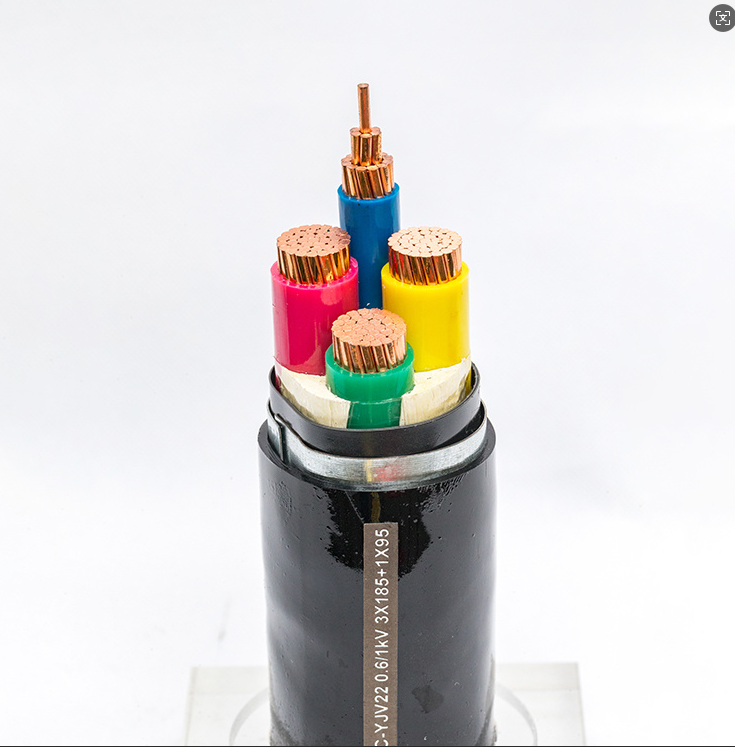
I. Core Function: Cross-Sectional Area Determines the "Carrying Capacity" of Cables
The core function of low-voltage cables is to transmit electricity, and the cross-sectional area is the key factor determining their power carrying capacity. Simply put, the larger the cross-sectional area of the cable, the larger the cross-sectional area of the conductor, the smaller the resistance, and the larger the current that can pass safely per unit time (i.e., "current-carrying capacity"). On the contrary, the smaller the cross-sectional area, the larger the resistance, and the smaller the current-carrying capacity.
This principle is derived from Ohm's Law in electricity, where the resistance of a conductor is inversely proportional to its cross-sectional area. In household electricity scenarios, high-power electrical appliances such as air conditioners, electric water heaters, and induction cookers generate large currents during operation. If the selected cable cross-sectional area is too small, the current-carrying capacity cannot match the current demand of the electrical appliances, leading the cable to be in an overloaded state for a long time. For example, a 2.5mm² copper core low-voltage cable has a long-term allowable current-carrying capacity of about 25A, which can meet the electricity demand of a 2-ton air conditioner (about 1.5kW); if a 1.5mm² cable (long-term allowable current-carrying capacity of about 18A) is used to connect a 2-ton air conditioner, overload will occur due to insufficient current-carrying capacity.
II. Key Impacts: 4 Major Safety and Efficiency Hazards of Insufficient Cross-Sectional Area
Improper selection of low-voltage cable cross-sectional area, especially insufficient cross-sectional area, will threaten electrical safety, reduce power supply efficiency, and even shorten equipment service life from multiple dimensions. The specific manifestations are as follows:
1. Overload Heating, Causing Fire Risks
When a cable transmits current, heat will be generated due to the resistance of the conductor, which is an inevitable physical phenomenon. Under normal circumstances, a cable that meets the current-carrying capacity requirements can dissipate the generated heat in a timely manner through the insulation layer and air, and the temperature remains within a safe range. However, if the cross-sectional area is too small, the resistance will increase, the heat generated per unit time will increase significantly, and the heat dissipation efficiency cannot be improved synchronously, leading to a continuous rise in cable temperature. When the temperature exceeds the tolerance limit of the insulation layer (the tolerance temperature of ordinary PVC insulated cables is about 70℃), the insulation layer will accelerate aging, soften, and break, which will then cause conductor short circuits, generate electric sparks, ignite surrounding combustibles, and cause fire accidents. According to fire statistics, about 30% of household electrical fires are related to insufficient cable cross-sectional area and overload heating.
2. Excessive Voltage Drop, Affecting Normal Operation of Equipment
Voltage drop refers to the voltage loss caused by conductor resistance when current passes through the cable. The smaller the cable cross-sectional area, the larger the resistance, and the more obvious the voltage drop. In low-voltage power supply systems, the voltage drop must be controlled within a certain range (it is recommended that the voltage drop for household electricity does not exceed 3%), otherwise the normal operation of electrical appliances will be affected.
For example, if the kitchen of a family is far from the distribution box, and a 1.5mm² cable is used to connect an induction cooker (rated voltage 220V), when the induction cooker is working, the voltage drop of the cable may exceed 5%, resulting in the actual supply voltage being lower than 210V. The induction cooker will have problems such as reduced heating power and difficulty in starting; for precision equipment (such as computers and printers), excessive voltage drop may also cause equipment crashes and data loss. Using a cable with a larger cross-sectional area (such as 2.5mm²) can effectively reduce resistance, control the voltage drop within a safe range, and ensure the normal operation of the equipment.
3. Accelerate Cable Aging and Shorten Service Life
The service life of a cable is directly related to the operating temperature. The higher the temperature, the faster the aging speed of the insulation layer. Overload heating caused by insufficient cross-sectional area will make the cable work at a high temperature for a long time, greatly shortening its service life. The design service life of ordinary low-voltage cables is about 15-20 years. If they are overloaded and heated for a long time, the service life may be shortened to 5-10 years or even shorter.
In addition, high temperature will also reduce the mechanical properties of the insulation layer, making it brittle and easy to crack, increasing the risk of leakage. For cables laid in walls or through pipes, replacement is difficult and costly. Premature aging caused by insufficient cross-sectional area will bring additional maintenance costs and safety hazards to users.
4. Increase Energy Consumption and Reduce Power Supply Efficiency
Cables with too small cross-sectional area have larger resistance. According to Joule's Law, the heat generated by current passing through the resistance will cause power loss (commonly known as "line loss"). Line loss is proportional to resistance; the larger the resistance, the higher the line loss. In the long-term electricity use process, the accumulation of line loss will lead to an increase in electricity consumption and higher electricity costs.
For example, if the annual electricity consumption of a family is 10,000 kWh, and the line loss rate increases by 2% due to insufficient cable cross-sectional area, 200 kWh of electricity will be wasted every year, equivalent to an additional electricity fee of about 120 yuan (calculated at 0.6 yuan/kWh); for small commercial premises, the cost pressure brought by increased line loss will be more obvious. Selecting a cable with an appropriate cross-sectional area can effectively reduce resistance and line loss, improve power supply efficiency, and save electricity costs.
III. Scientific Selection: Principles for Selecting Low-Voltage Cable Cross-Sectional Area
Since the cross-sectional area of low-voltage cables is so important, how to choose scientifically? The core principle is "matching current-carrying capacity, controlling voltage drop, and reserving redundancy". The specific reference can be made to the following three points:
1. Calculate Current-Carrying Capacity According to Load Power and Match Cross-Sectional Area
Before selecting the cable cross-sectional area, it is necessary to first calculate the total load power of the electrical circuit, then calculate the required current according to the power (current = power ÷ voltage ÷ power factor, and the power factor for household electricity is calculated as 0.9), and finally select the corresponding cable cross-sectional area according to the current. For example, the total load power of a household kitchen is about 6kW (including induction cooker, microwave oven, electric oven, etc.), and the calculated current is about 6000 ÷ 220 ÷ 0.9 ≈ 30.3A. A 4mm² copper core low-voltage cable (long-term allowable current-carrying capacity of about 35A) should be selected to ensure that the current-carrying capacity matches.
It should be noted that the conductivity of copper core cables is better than that of aluminum core cables. Under the same cross-sectional area, copper core cables have larger current-carrying capacity. It is recommended that copper core cables be preferred for households and commercial premises.
2. Consider the Laying Method and Appropriately Increase the Cross-Sectional Area
The laying method of the cable will affect the heat dissipation effect, thereby affecting the current-carrying capacity. Cables laid in walls, through pipes, or on cable trays have poor heat dissipation conditions. Under the same load, cables with larger cross-sectional areas should be selected than those laid in the open air, or used with reduced current-carrying capacity. For example, the current-carrying capacity of a 2.5mm² copper core cable laid in the open air is about 25A; if it is laid in a pipe and buried in the wall, the current-carrying capacity will drop to about 20A. At this time, if the load current is 22A, a 4mm² cable should be selected.
3. Reserve Redundancy to Cope with Future Increases in Load
The electricity demand of households and commercial premises may increase with the addition of equipment. When selecting the cable cross-sectional area, a certain amount of redundancy should be reserved to avoid cable overload due to increased load. For example, during new house decoration, 2.5mm² copper core cables can be used for circuits such as living rooms and bedrooms, and 4mm² copper core cables can be used for circuits with concentrated high-power electrical appliances such as kitchens and bathrooms. Even if electrical equipment is added in the future, the electricity demand can be met.
IV. Correct Common Misunderstandings: Not the Larger the Better, but Precise Matching
It should be noted that the cross-sectional area of low-voltage cables is not the larger the better. A too large cross-sectional area will lead to an increase in cable cost (the cost of copper core cables is proportional to the cross-sectional area), and at the same time, the outer diameter of the cable will increase and the flexibility will decrease, increasing the difficulty of laying and construction costs. For example, using a 6mm² cable to connect an ordinary socket (load current about 5A) is safe, but it will cause material waste and increase decoration costs. Scientific selection is to "precisely match the load demand", and select the most cost-effective cross-sectional area on the premise of the current-carrying capacity and controlling the voltage drop.
Related Articles More>>
- Why Are Low-Voltage Cables So Important in Home Renovation? A Core Guarantee for Safety and Comfort
- Will PV Cables Become Brittle in Low-Temperature Environments? Complete Analysis of Answers and Solutions
- How to Make High-Voltage Cable Intermediate Joints More Reliable? Full-Process Specifications + Quality Control Points
- How to Quickly Repair Damaged Insulation Layer of High-Voltage Cables? Full-Process Guide + Safety Points
